
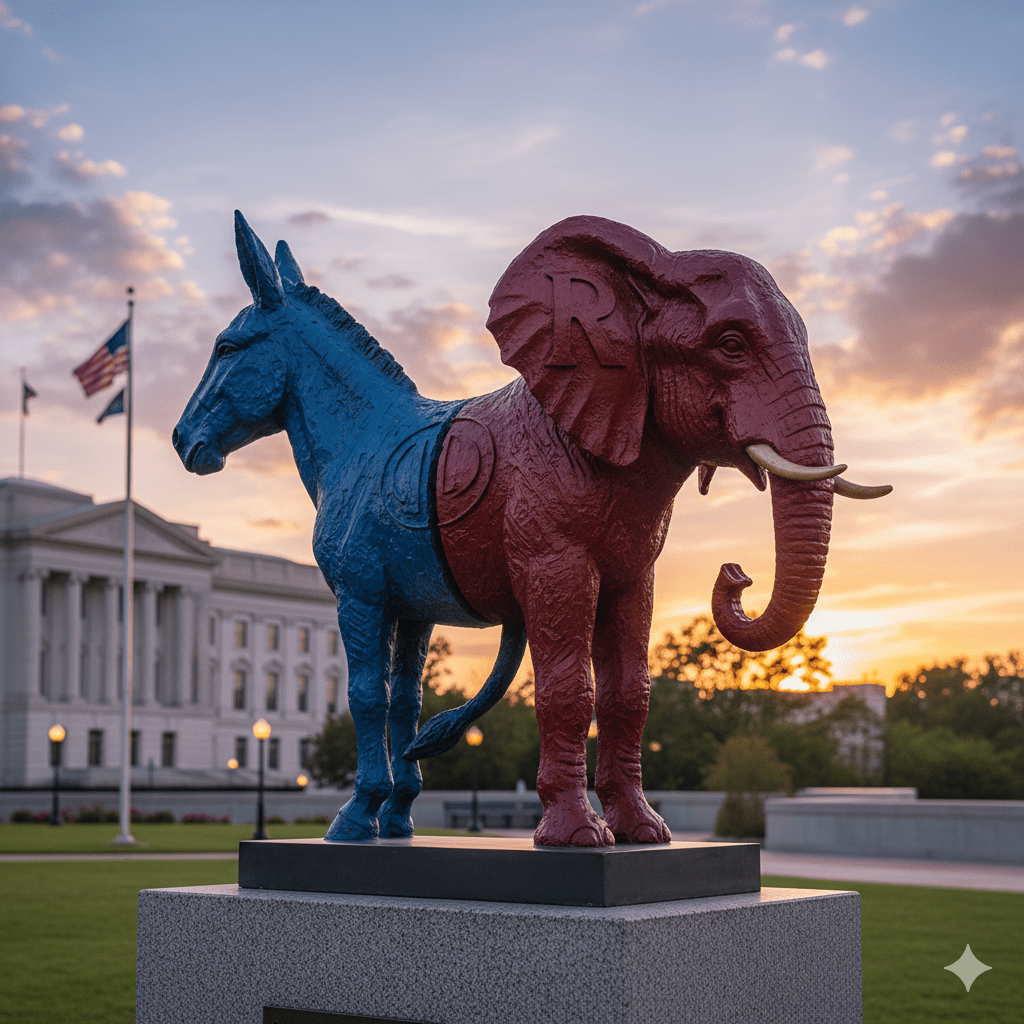
This IS A COMPLEX STORY OF MULTIPLE SPLITS AND IDEOLOGICAL FLIPS OVER TWO CENTURIES, NOT A SINGLE, CLEAN SEPARATION.
HERE IS AN OVERVIEW OF THEIR ORIGINS AND THE KEY REALIGNMENTS THAT LED TO THEIR MODERN IDENTITIES:
The Origins (Late 18th & Early 19th Century)
The current Democratic and Republican trace their lineage back to the same party. They formed at different times from different splits.
- The Democratic Party (Founded c. 1828):
- Direct Ancestor: The Democratic-Republican Party (or Jeffersonian
Republicans), founded around 1792 by Thomas Jefferson and James Madison to oppose the Federalist Party’s push for a strong central government.
○ The Split: After the “Era of Good Feelings” (where the Democratic-Republicans were the only major party), the party splintered in the 1824 election. The faction led by Andrew Jackson eventually formed the modern Democratic Party around 1828. This early Democratic Party generally championed states’ rights, an agrarian society, and the “common man.”
- The Republican Party (Founded 1854):
- Direct Ancestor: A coalition of anti-slavery activists, former members of the Whig Party, and Free-Soilers.
○ The Split: The Republican Party was formed in 1854 specifically to oppose the expansion of slavery into the western territories, spurred by the Kansas-Nebraska Act. This early Republican Party was considered the more liberal/progressive party of the time, leading the North during the Civil War under Abraham Lincoln.
The Great Realignment Over Slavery (1850s–1930s)
During this period, the parties’ ideologies were largely defined by the aftermath of the Civil War:
- Republican Party (GOP): Dominated the North. It was the party of big business, industrialization, and protecting the rights of newly freed African Americans during Reconstruction.
- Democratic Party: Dominated the South (The Solid South). It became the conservative party, largely representing agrarian interests and promoting white supremacy through policies like Jim Crow after the end of Reconstruction.
The New Deal Realignment (1930s)
The Great Depression was a major turning point that began the long process of flipping the parties’ economic ideologies:
- Democratic Party: Under Franklin D. Roosevelt (FDR), the party embraced a new, progressive vision of an active, large federal government with the New Deal programs.
This formed a broad coalition. It included Northern and Western progressives and labor unions. African Americans, who switched from the Republican Party, were also part of it. Additionally, the conservative Southern wing was included.
- Republican Party (GOP): Largely opposed the New Deal. They viewed the expansion of the federal government and the creation of a social safety net as threats to individual liberty. They also saw it as a threat to free-market principles. The GOP began to define itself as the party of fiscal conservatism and limited government.
The Civil Rights and Southern Realignment (1960s–1980s)
This was the final, decisive event that essentially completed the flip of the parties’ core regional and social coalitions:
- The Catalyst: Democratic President Lyndon B. Johnson signed the Civil Rights Act of 1964 and the Voting Rights Act of 1965.
- The Flip: These acts alienated the party’s conservative, segregationist Southern wing. As President Johnson famously predicted: “We’ve just lost the South for a generation.”
○ Democratic Party: Solidified its identity as the party championing civil rights and social justice. It promotes a more expansive role for government in social and economic affairs (modern liberalism/progressivism).
○ Republican Party (GOP): Adopted the Southern Strategy, which appealed to the conservative white voters leaving the Democratic Party. The party began to emphasize themes of “law and order,” states’ rights, and eventually, social conservatism (modern conservatism).
By the 1980s, this realignment was largely complete, with the parties adopting the ideological positions and regional bases recognizable today.

 kbpublishing/wmstickellom.com
Leave a comment