
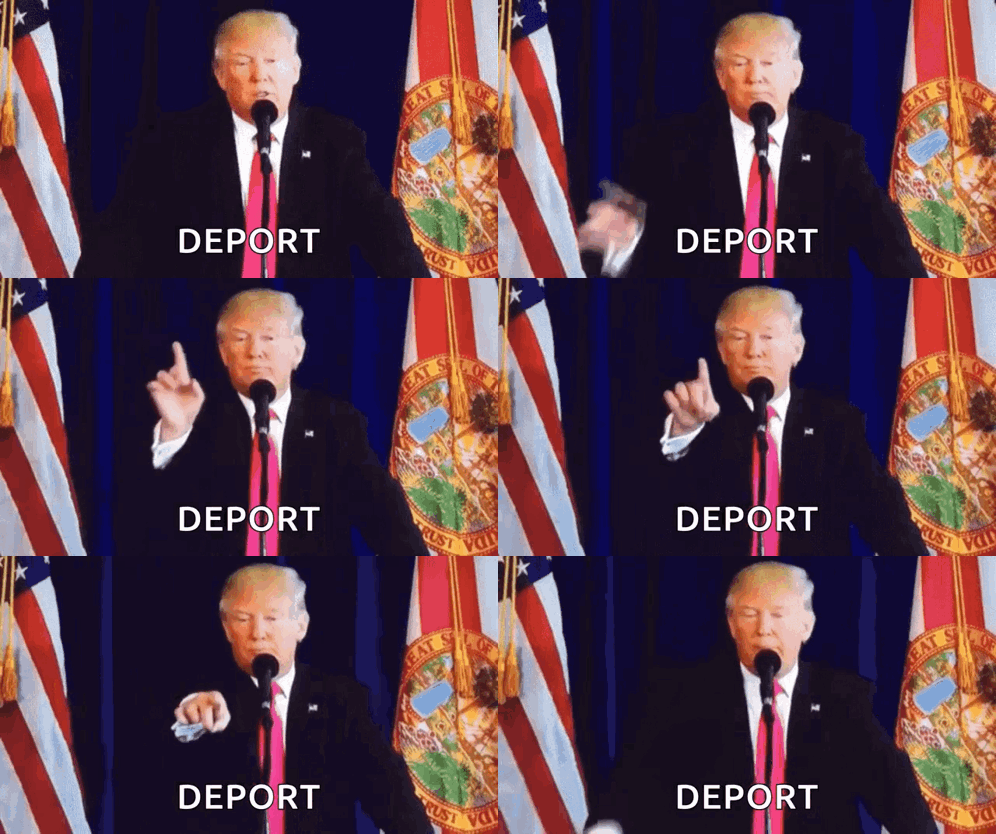
The liberals did this? What did this agent mean? Does this agent understand what he has said? While researching this political ideology of wanting to be free, I unfortunately, have to ask some more questions. The agents are my brothers and sisters who are all Americans, who have claimed their country the freest country in the world. Fuck! I did too! At 18, like so many, I joined the military. The Army National Guard is a part of a state’s military forces. The forces are trained and supplied by the Federal government. The Guard goes through the same training as the regular military. I wanted to be in the military so bad.
Even as a young boy, I liked the ganja. I didn’t like to drink alcohol, I did though, I was crying inside, and the pain from all the unfavorable childhood events,( I truly am being light) I was trying to feel better so I drank sometimes. Sometimes, it was not always, weekends, and not every weekend of course. I was just a teenager unable to buy alcohol so of course became a scavenger for some drink and some connections with people. The town where we lived was very small maybe 3000 people for a population. Not unsuspecting I was introduced to weed. If you consume cannabis 3 times in 1 month, you will have a dirty urinalysis which is not allowed in the military. Long story short is this; I knew the idea of freedom is what this country is about. Alcohol gets out of your digestive tract very fast, in fact, within hours. I went threw basic training, 10 weeks for myself but most do it 9 weeks including in-processing (The eye doctor messed up my glasses). Even in the basics, I was able to obtain some and shared with some other like-minded people. When I finished training and returned to my home state. After 5 years of a 6-year contract, the local command was given an order to do a random drug test on the whole battalion. I was one of them. I knew that I wouldn’t pass so I refused to take it. The battalion command had its orders from its commander and was ordered to interview at a drug council facility to declare if I had a drug problem. I did and I then withdrew from the guard. There were a lot of drinkers in the military and it didn’t seem fair nor did it feel like freedom. I have been a non-believer in this country ever since. Never voted for a Republican or Democrat in adult life.
What is happening in the present in my country is a bit scary because of the volatile militias’ actions by the current Republican government that is taking not only illegal aliens but also citizens who look Hispanic and don’t have their papers they are taken to a facility where they are held. This administration has sent the National Guard of Washington DC to do nothing but antagonize the evil liberals into a violent revolt of some type. The Liberals are for the most part non-violent people, so it might not happen. That is the point they know that they can do whatever they want to do to the liberals.
I want the illegal immigrants out also, with a lawful do-process. Why are they, the ICE agents saying the liberals did this? Joe Biden is not a liberal, he is a Democrat. Both major parties have taken away personal freedoms from the American people also.
Here is an AI helping on the history of what it means to be liberal.Certainly! Here’s a well-rounded article on the **history of liberalism**, tracing its evolution from its philosophical roots to its modern political expressions:
—
# **The History of Liberalism: From Enlightenment to Modern Democracy**
Liberalism is one of the most influential political ideologies in the modern world, shaping the foundations of democratic governance, civil liberties, and market economies. Its history is rich and complex, evolving through centuries of philosophical thought, political upheaval, and social transformation.
## **Origins in the Enlightenment**
Liberalism emerged during the **Age of Enlightenment** in the 17th and 18th centuries, a period marked by intellectual revolutions in Europe. Thinkers like **John Locke**, **Baron de Montesquieu**, and **Jean-Jacques Rousseau** laid the groundwork for liberal thought by emphasizing reason, individual rights, and the social contract.
– **John Locke** (1632–1704) is often considered the father of liberalism. He argued that individuals possess natural rights to life, liberty, and property, and that governments exist to protect these rights.
– Enlightenment liberalism was deeply skeptical of absolute monarchy and divine right, advocating instead for constitutional government and the rule of law.
## **Classical Liberalism (18th–19th Century)**
The ideas of the Enlightenment found political expression in events like the **American Revolution (1776)** and the **French Revolution (1789)**. These revolutions were driven by liberal ideals of freedom, equality, and representative government.
During the 19th century, **classical liberalism** became a dominant force in Western politics. Key features included:
– **Limited government** and protection of individual liberties.
– **Free markets** and economic liberalism, championed by thinkers like **Adam Smith**.
– **Freedom of speech**, religion, and press.
Prominent figures such as **John Stuart Mill** expanded liberalism to include ideas of utilitarianism and individual autonomy, advocating for women’s rights and broader democratic participation.
## **Social Liberalism (Late 19th–20th Century)**
As industrialization progressed, classical liberalism faced criticism for failing to address economic inequality and social injustice. This led to the rise of **social liberalism**, which sought to balance individual freedoms with social welfare.
– Thinkers like **T.H. Green** and **Leonard Hobhouse** argued that true freedom required access to education, healthcare, and economic opportunity.
– Governments began to adopt policies like labor protections, public education, and social security, especially in the wake of the **Great Depression** and **World War II**.
Social liberalism became the foundation for many modern welfare states, particularly in Europe and North America.
## **Neoliberalism and Contemporary Liberalism (Late 20th–21st Century)**
In the late 20th century, a new wave of liberal thought emerged known as **neoliberalism**, emphasizing deregulation, privatization, and globalization. Influential leaders like **Margaret Thatcher** and **Ronald Reagan** promoted neoliberal policies to revive stagnant economies.
However, neoliberalism has faced criticism for increasing inequality and weakening public institutions. In response, contemporary liberalism has become more diverse, encompassing:
– **Progressive liberalism**, focusing on social justice, environmental sustainability, and inclusion.
– **Centrist liberalism**, advocating pragmatic governance and market-friendly reforms.
– **Libertarianism**, a radical form of liberalism emphasizing minimal state intervention.
## **Liberalism Today**
Today, liberalism remains a cornerstone of democratic societies, though it faces challenges from rising populism, authoritarianism, and political polarization. Debates continue over how best to balance freedom with equality, individual rights with collective responsibility, and national interests with global cooperation.
Despite these tensions, liberalism’s enduring legacy is its commitment to human dignity, rational discourse, and the belief that societies can be improved through reason and reform.
—

 kbpublishing/wmstickellom.com
Leave a comment